Have you ever looked at a loan offer and wondered whether the interest percentage is actually costing you more than the lender claims? Many borrowers focus on the monthly payment and ignore the real cost hiding behind the numbers. A loan’s small percentage can quietly add thousands of dollars—or rupees—to your total repayment. The fact that most people sign loan agreements without fully comprehending how interest is calculated is the surprising part. It’s similar to driving a car without knowing how much gas it uses: you might get there, but you’ll probably spend more money than you planned. Understanding how to calculate interest percentage on a loan gives you control over your finances. Knowing the math behind interest helps you compare offers, negotiate better rates, and avoid costly mistakes whether you are taking out a personal loan, car loan, student loan, mortgage, or business loan. According to recent lending data, average personal loan interest rates typically range between 6% and 36%, depending on creditworthiness and lender policies.
Before signing any loan agreement, learning how interest works can save significant money over time. Everything is explained in plain English in this guide, so even if you don’t know a lot about math, you’ll still be able to confidently calculate loan interest.
What is interest on a loan?
The amount a lender charges you for borrowing money is called loan interest. It’s like paying a rental fee to use someone else’s money. When a bank, credit union, or online lender gives you a loan, they expect to earn something in return for taking the risk of lending. That earning comes in the form of interest.
You won’t just pay back the $10,000 you borrowed, for instance, if the lender charges an annual interest rate of 10%. In accordance with the terms that were agreed upon, you will repay the amount that was borrowed in addition to the interest that was charged. The exact amount depends on how the lender calculates interest.
Interest rate and APR (Annual Percentage Rate)
Many borrowers confuse interest rate and APR (Annual Percentage Rate). While they seem similar, APR often includes additional fees associated with the loan. When you know the difference, you can accurately compare loan offers. According to recent financial reports, borrowers with strong credit histories typically pay significantly lower interest rates than borrowers with weak credit histories. Why Interest Is Charged by Lenders Imagine lending $5,000 to a friend for two years. You won’t be able to put that money to use or invest it during that time. Lenders face the same situation. They are compensated by interest for the risks of opportunity costs, inflation, and borrower default. Banks also use interest income to cover operational expenses and generate profits. The interest rate typically rises in proportion to the borrower’s perceived level of risk. This explains why a person with excellent credit may be eligible for a rate that is significantly lower than that of someone with poor credit. The lender essentially prices risk into the interest percentage. By comprehending this concept, borrowers are able to comprehend why enhancing one’s financial profile prior to applying for a loan can significantly reduce borrowing costs.
Different Types of Loan Interest
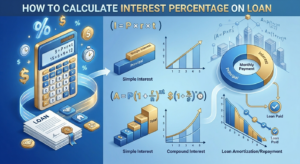
Simple Interest
Simple interest is the easiest type of loan interest to calculate. It is charged only on the original principal amount borrowed. The interest doesn’t accumulate on previously earned interest.
The formula is:
I=P\times R\times T
Where:
I equals interest P = Principal amount
Rate of interest, R T = Time
Many short-term loans use simple interest because it is straightforward and transparent.
Compound Interest
Compound interest works differently. Instead of charging interest only on the principal, lenders charge interest on both the principal and accumulated interest.
People often call compound interest the “snowball effect.” Imagine rolling a small snowball down a hill. It starts tiny but grows rapidly as more snow sticks to it. Compound interest behaves similarly.
The loan becomes more expensive the more frequently interest increases. Monthly compounding generally results in higher costs than annual compounding.
Amortized Interest
Amortization schedules are used in the majority of personal loans, auto loans, and mortgages. In these loans, borrowers make fixed monthly payments. Early payments contain a larger interest portion, while later payments contain more principal repayment.
Because it provides predictable monthly payments while gradually reducing the outstanding balance, amortized interest is frequently utilized by financial institutions. The Basic Formula for Calculating Interest Percentage

Understanding the Variables
Before calculating loan interest, you must understand three critical elements:
- Variable
- Meaning
- Principal
- Amount borrowed
- Default Rate Percentage charged annually
- Time
- Duration of the loan
The total cost of borrowing is determined by these three factors. Step-by-Step Formula Breakdown
Suppose you borrow $20,000 at an annual interest rate of 8% for three years.
Using the simple interest formula:
I=20000\times0.08\times3
$4,800 in interest Total amount due: $20,000 + $4,800 = $24,800
This calculation provides a clear picture of how much extra you’ll pay beyond the original loan amount.
How to Calculate Simple Interest on a Loan
Real-Life Example
Let’s walk through a practical example.
Imagine Sarah borrows $15,000 to renovate her home. Her lender provides a four-year simple interest rate of 7% annually. Applying the formula:
I=15000\times0.07\times4
Interest = $4,200
Total amount due: $15,000 + $4,200 = $19,200
This means Sarah pays $4,200 solely for the privilege of borrowing the money. She gets a better understanding of the true cost of the loan when it is broken down in more detail rather than just the monthly payments. Simple interest calculations are particularly useful when comparing short-term borrowing options because they provide transparent cost estimates without complicated compounding structures.
For borrowers who want quick estimates without manual calculations, using a loan calculator can simplify the process. Fivtool.com/loan-calculator is a reliable tool for estimating monthly payments and interest costs for various loan scenarios.
How to Calculate Compound Interest on a Loan
A = Final amount
P = Principal
r = Interest rate
n = Number of compounding periods
t = Time
This formula reflects how interest accumulates over time.
Sample Calculation
Assume you borrow $10,000 at 10% annual interest compounded monthly for three years.
The lender recalculates interest every month based on the current balance. This means each month adds slightly more interest than simple interest would.
Many borrowers underestimate compound interest because the growth appears slow initially. Yet over longer periods, compound interest dramatically increases repayment costs.
Before signing any loan agreement, it is essential to comprehend compounding frequency. Even a seemingly small difference between monthly and annual compounding can result in substantial additional expenses.
How Amortized Loan Interest Works
Monthly Payments Explained
Today, the lending market is dominated by amortized loans. This is typically the structure that is used for personal loans, auto loans, and mortgages. Throughout the duration of the loan, borrowers make regular payments rather than varying amounts each month. At first glance, fixed monthly payments seem simple. The complexity appears when examining how those payments are allocated. During the early stages, a larger portion goes toward interest. Each payment decreases principal as the balance decreases. Many borrowers are surprised to discover that they pay most of their interest during the first half of the loan term. This structure explains why making extra payments early often creates significant savings.
Interest vs Principal
Imagine a loan payment as two slices of a pie: Slice the interest The main slice At the beginning, the interest slice is large and the principal slice is small. Those proportions gradually fall off over time. According to financial lending guides, amortized loans are designed to maintain equal monthly payments while steadily reducing the outstanding balance. Understanding this structure helps borrowers make smarter decisions regarding refinancing and early repayment strategies.
Factors That Affect Loan Interest Percentage
Credit Score
Your credit score acts like a financial report card. It is used by lenders to determine how risky lending you money might be. The advertised rates are frequently offered to borrowers who have excellent credit. Those with lower scores may face significantly higher rates because lenders perceive greater repayment risk. According to recent lending data, borrowers with strong credit histories consistently obtain loan terms that are more favorable. Improving your credit score before applying can save thousands over the life of a loan.
Loan Term
Typically, loans with longer terms have lower monthly payments but higher total interest costs. For example:
- Loan Term
- Monthly Payment
- Total Interest
- 3 Years
- Higher
- Lower
- 7 Years
- Lower
- Higher
Many borrowers focus solely on affordability and overlook the increased interest expense associated with extended repayment periods.
Market Interest Rates
Economic conditions influence lending rates. The availability of loan rates is affected by a variety of factors, including inflation rates, market competition, and central bank policies. When benchmark rates rise, borrowing becomes more expensive. When rates fall, borrowers often enjoy better financing opportunities.
Before signing a loan agreement, it is still one of the best financial decisions to compare multiple lenders.

Using Online Loan Calculators
Loan calculators offer speed and accuracy, whereas manual calculations are helpful for comprehending concepts. They enable borrowers to immediately test a variety of scenarios. You can use a quality calculator to:
- Make an estimate of your monthly payments.
- Compare the terms of the loan.
- Analyze interest costs
- Plan repayment strategies
Recognize the affordability You can quickly experiment with various rates, loan amounts, and repayment terms instead of spending hours crunching numbers. Loan calculators are especially valuable when comparing multiple loan offers because they reveal the true cost behind marketing claims. Two loans with similar monthly payments may have dramatically different total interest expenses.
Financial decision-making is transformed from guesswork to informed planning when calculation tools are utilized prior to borrowing.
Common Errors in Loan Interest Calculation
When evaluating loan offers, many borrowers make mistakes that could have been avoided. One common error is focusing exclusively on monthly payments. Although shorter terms and higher overall interest costs are frequently associated with lower payments, they frequently feel appealing. Another mistake is ignoring APR. Even if a loan has a low advertised interest rate, the actual cost of borrowing may be increased by substantial fees. Borrowers also underestimate compound interest. Small percentage differences appear insignificant initially but can create large repayment differences over several years.
Loan comparisons can also be distorted if additional costs like processing fees, late payment penalties, and origination fees are not taken into account. Instead of relying solely on promotional rates, experts in the financial industry always recommend reading the entire loan disclosure. The best borrowers consider the entire financial picture rather than just the headline rate. Tips to Reduce the Interest You Pay
To cut down on interest costs, you don’t have to be a financial wizard. A significant difference can be made by a few strategic choices. Before applying, improve your credit score first. Paying bills on time, reducing debt utilization, and correcting credit report errors can strengthen your negotiating position.
Consider making extra payments whenever possible. Since many loans calculate interest based on remaining balances, reducing principal early often leads to significant savings.
Shopping around also matters. Different lenders evaluate risk differently. Comparing multiple offers increases the likelihood of securing a competitive rate.
Although shorter loan terms typically result in significant reductions in total interest costs, they can increase monthly payments. Refinancing can also become valuable when market rates decline. Borrowers who monitor rate trends often discover opportunities to lower their borrowing expenses over time.
Conclusion
One of the most useful financial skills you can acquire is the ability to calculate a loan’s interest percentage. It allows you to evaluate loan offers confidently, avoid unnecessary costs, and make smarter borrowing decisions. It doesn’t matter if you’re dealing with amortized loans, compound interest, or simple interest—knowing the math behind the numbers gives you a big advantage. Loans don’t have to be confusing. The borrowing process becomes much more transparent once you understand how principal, interest rates, loan terms, and repayment structures interact. You can independently verify costs and determine the best deal instead of relying solely on explanations provided by lenders. You’ll know exactly what questions to ask the next time you get a loan offer and, more importantly, how to figure out if the loan is really worth it financially.
FAQs
1. What is the easiest way to calculate loan interest?
The easiest method is using the simple interest formula:
I=P\times R\times T
Multiply the principal amount by the annual interest rate and loan duration.
2. Is APR the same as interest rate?
No. Interest rate represents borrowing cost, while APR includes interest plus certain lender fees, making it a more accurate measure of total loan cost.
3. Why do banks use amortized interest?
Amortization provides predictable monthly payments while gradually reducing the loan balance. Most mortgages, auto loans, and personal loans use this system.
4. Does paying off a loan early reduce interest?
Yes. Since interest is often calculated on the remaining balance, early repayments usually reduce total interest costs significantly.
5. How can I get a lower loan interest rate?
Improve your credit score, maintain stable income, reduce existing debts, compare lenders, and consider shorter loan terms to qualify for better rates.
.